9376
4wVBT No. 9376
Builder : Sentinel Date Built: 1947 Works No.: 9376
Running No.: 7 Tractive Effort:- 5,960 / 15,960 lb Boiler Pressure: 275 psi
Cylinder Dimensions:- 6¾" x 9" Weight:- 24T Driving Wheel Dia.: 2' 6" Status: Stored
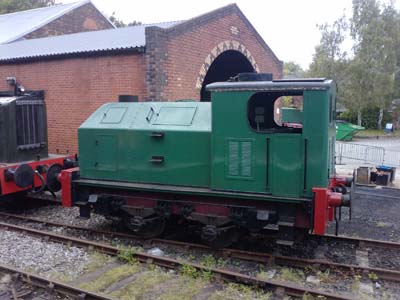
Sentinel No. 9376 was built in 1947 for Ind Coope and Allsop, and was used at their Burton Brewery. During 1960 it was sold to Thomas Hill Ltd. of Kilnhurst, near Rotherham. From February to May that year the locomotive was loaned to Batchelor's Foods Ltd. of Wadsley Bridge. It then received a rebuild before sale to the National Coal Board in July. The NCB used No. 9376 at East Ardsley Colliery near Wakefield for three years before reselling it to Thomas Hill in 1963. Two years later the engine was on the move again, this time being purchased by General Refractories Ltd. of Deepcar, Sheffield. From about 1969, a small Ruston diesel was found sufficient for the company's rail traffic and No. 9376 lay out of use until 1971. In July 1971 the locomotive was purchased by a member of the Sentinel Trust and moved to Quainton. 9376 is similar to, but an older version of, Sentinel 9537 which is at the Buckinghamshire Railway Centre.
9376 arrived at the Rutland Railway Museum Cottesmore in working order and worked at Barrington Cement Works, near Cambridge, as well as at Rutland Railway Museum open days. Few problems, other than the eccentricities of the locomotive, were experienced. The first problem arose due to a steam leak, when welded modifications were required to reduce clearances around mud hole doors to reduce the risk of further leaks. Problems were also been experienced with a loose piston in the left hand cylinder, this and problems with oiling, meant the locomotive was out of service for 1997. During the layoff, some wasted studs were replaced, the pressure gauge was recalibrated, and a tank drain leak repaired. The locomotive passed its hydraulic and steam tests and returned to service. Due to the gradients at Cottesmore (approx. 1 in 66), No. 9376 was not ideally suited to continuous heavy working, but regularly performed on demonstration freight trains or running light locomotive.
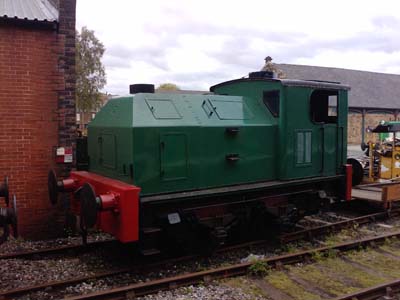
In this engine the drive passes via a two speed gear box through a double chain to the leading axle. This is connected to the rear axle by single chain on the opposite side. The space between the boiler and the cylinders at the front of the engine is occupied by a 500 gallon water tank. The locomotive is currently stored with no intention of returning to service and is being used to supply parts for William and Gervase.
Earl Fitzwilliam
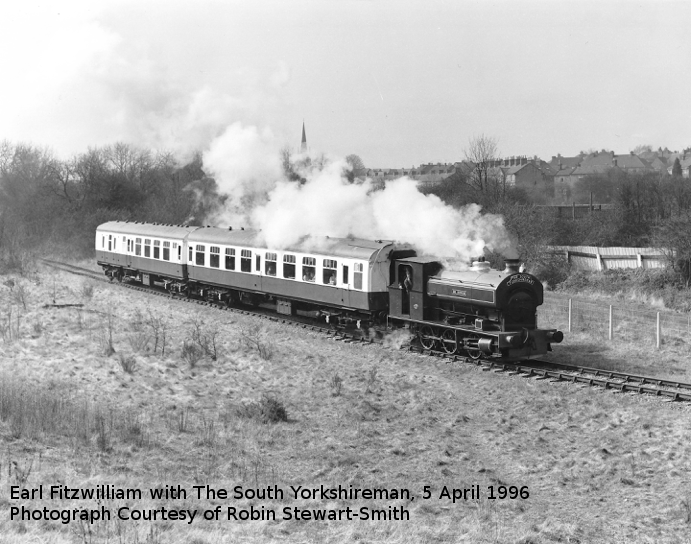
Avonside W/No.1917 0-6-0ST Earl Fitzwilliam
Builder: Avonside Class: B4 Built: 1923 Weight: 28T Boiler Working Pressure: 160psi
Status: Awaiting Overhaul
No. 1917 was originally named Pitsford and was owned by Pitsford Ironstone Quarries in Northampton. When bought for preservation she was moved to the Fawley Hill Railway, until 1972 when she moved to the Nene Valley Railway. 1917 left the Nene Valley Railway and was overhauled, repainted and named Earl Fitzwilliam, for use on the Elsecar Heritage Railway. No. 1917 was withdrawn from Elsecar Heritage Railway services in 2002 after ten years hard work for the railway. This locomotive was the main workhorse on passenger services from when the railway began operating services in the early 1990's, until withdrawal from service in 2001. It is currently awaiting overhaul.
Mardy Monster
No.2150 0-6-0ST Mardy Monster
Builder: Peckett & Sons Built: 1954 Weight: 55T Boiler Working Pressure: 200psi
Tractive Effort: 29,527 lbs Cylinder Dimensions: 18” x 26” Heating Surface Area: 921 sq ft
Grate Area: 19.1 sq ft Status: Under Overhaul

No. 2150 was built by Peckett & Sons, Bristol, in 1954 and was one of only three of the OQ class constructed. The locomotive weighed in at 55 tons with cylinder dimensions of 18” x 26” the heating surface is a massive 921 sq ft with a grate area of 19.1 sq ft. Driving wheels of 4 1/2 ft and a working pressure of 200 lbs per square inch makes this loco the most powerful industrial steam locomotive ever built in the UK. Adding all the above dimensions together, the nominal tractive effort is 29,527 lbs at 85% efficiency, which compares to a 7F on British Railways.
With this in mind, it is little wonder that the engine was nicknamed the “Mardy Monster.” The picture shows the massive size of the OQ Class Peckett. Maerdy is a small town in the Rhondda Valley where No.2150 and its twin sister No. 2151 spent all their working lives at the very steeply graded Maerdy Colliery. Its loud staccato exhaust beat could be heard for miles around as it heaved heavy coal trains of up to 45 wagons up the steep colliery inclines. The locomotive remained in service until 1976 when it was withdrawn. After No. 2150 was withdrawn, it stood idle for three years before being purchased for preservation on the embryonic Swanage Railway. It had a little work done on it before being abandoned in favour of main line locos which were more appropriate for the expanding Purbeck line. After 18 years the engine was purchased for the Elsecar Railway, Barnsley, and restoration has continued steadily.
On the 21st/22nd June 2003 the locomotive was launched into regular passenger traffic on Elsecar Heritage Railway, following a £70,000 restoration.
Dignitaries including the Mayor’s of Barnsley, Rotherham, Doncaster and the Lord Mayor of Sheffield were all in attendance for the Relaunch. At the official launch weekend, held in early summer 2003, a Male Voice Choir from the Maerdy area and a Colliery Band and Male Voice Choir from South Yorkshire were present to take part in the festivities.
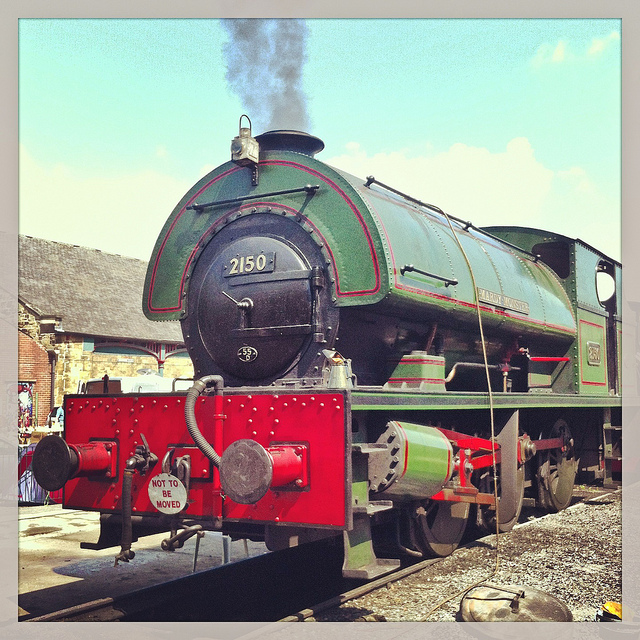
After 10 years service Mardy Monster's 10 year boiler certificate expired at the end of 2013. The engine is currently out of service receiving a complete boiler overhaul and maintenance work on bearings.
